How To Wash And Detail Your Car
This is not a joke. Many of us don’t know even how properly to wash our cars, thinking that a dirty bucket of washing up liquid and an old sponge will suffice, never mind about claying, waxing, sealing and other detailing techniques. This guide aims to set the record straight, enabling you to start detailing your car correctly right away.
Washing stage
This is the most frequent stage and should be done on a weekly basis where possible. First, if you have access to a hosepipe, use it to get off any excess dirt, insects and the like before you even touch the car. In any case use a bucket of clean water to get the car wet. Next, using the two bucket method, you should have two (clean) buckets of water ready, one containing shampoo and one with clean water. Don’t just use an old sponge for applying the shampoo, the best accessory to use is a lambswool mitt such as the ‘wookie’s fist’, but an ordinary sponge can be sufficient, provided it is completely clean and you don’t drop it on the floor. The advantage of a mitt is that it can get into the smallest cracks and crevices, it is kind to the car’s paintwork because the long pile can keep dirt away from the paint surface and it is less likely to fall on the floor (as it is worn like a glove).
Next you need to get the car dry; a microfibre towel such as Dodo Juice Soft Touch is good for this, and there are even dedicated drying agents such as Dodo Juice ‘Time to Dry’ which speed up the process and lubricate remaining dirt to help prevent marking of the paint by the action of the towel. You can leave the car to dry by itself of course, but naturally it takes more time and leaves open the possibility of water marks, dust, insects, leaves, cats and other bits and pieces already accumulating on your nice clean car.
Preparation stage
Usually washing is all that is required, plus a quick detailing spray (see below) but to really protect a car’s paintwork you have to be prepared to clay, and wax or seal the car’s paintwork.
Detailing clay is the only way of really getting deep, ingrained contaminants that will naturally become embedded into the paintwork over time, mostly from traffic pollution and industral fallout. These contaminants include microscopic metal particles from brake pads, brake discs and railway lines. Clay also removes bonded contaminants like tar and tree sap. Clay bars must be used together with a clay lube to prevent marring (marking) to the paint surface, because the clay is effectively a large block of polish. This stage only needs to be done once or twice per year.
For a really professional finish, before going to the wax stage, you would then use a polish or a pre-wax cleaner (for example Dodo Juice ‘Lime Prime’)
Pre-wax/Polishing Stage
Pre-wax / polishing Stage
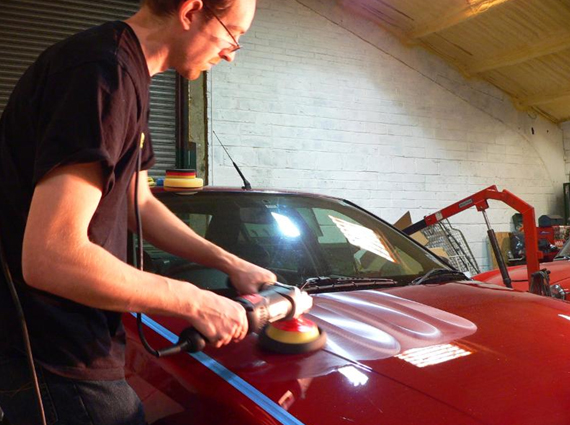
The polishing stage needs to be carried out every time you wax, but you would not normally need to machine polish as this can be destructive to a paint finish if carried out too often. Machine polishing can remove paint surface defects like swirl marks, scratches and holograms (a kind of imperfection which seems to move when viewed at different angles, hence the name). Often such imperfections will only show up under a powerful lamp and won’t be obvious during normal daytime conditions.
If you feel that the paintwork needs a machine polish, the best method is to use a hand held orbital polisher (see pic).
 .
.
It is recommended that you machine polish the car no more than twice per year, because you will be removing a small amount of the paint each time.
Hand polishing is far less destructive, and whilst it may not remove defects, it does get the paint surface clean and gives a good, clean and glossy finish for the wax or sealant to bond to. It is however very hard work, imagine comparing using a hand-powered drill as against an electric one.
Protection Stage
The protection stage is important in sealing your car’s paintwork, making sure all your hard work doesn’t go to waste the moment it starts raining or a bird decides to use it as a toilet. This can be achieved either with wax, or with sealant.
Wax comes in a variety of kinds, mainly depending on the colour of the car and also whether it is a ‘hard’ or ‘soft’ wax. Soft waxes, as their name would suggest, are easier to apply by fingertips and palms as they are oilier – but the recipe of the wax is far more important than its texture. It’s often down to personal preference which wax you use; it wouldn’t do any damage to apply a light coloured wax to a dark coloured car and vice versa, but of course for optimum results you should match the correct wax to the car.
Wax should be applied by hand, ideally using an applicator such as the Dodo Juice Supernatural Finger Mitt, only a little at a time to each panel sparingly, either by hand or with a foam applicator pad ( Supernatural Finger Mitt is perfect). It should be left to cure for some minutes and then buffed off with a clean microfibre cloth. You can apply a second layer some hours later.
Alternatively a sealant can be used, which performs the same job as a wax but normally contains a higher concentration of synthetic ingredients.
Maintain
This is the most frequent stage and can be done weekly or even daily if you wish. Quick detailing sprays or glazes can quickly bring your car’s bodywork back to life, giving it that ‘just detailed’ look.
The following summary helps to show the different stages in car detailing:
1)Wash (weekly):
Use proper car shampoos, sponges or wash mitts, drying towels and other accessories.
2) Clay (once or twice a year)
Use clay bar (for example Dodo Juice “Purposeful Purple”) and lubricant to remove contaminants from the paintwork that shampoos cannot remove.
3) Polish (two to four times per year)
Use polishes, glazes and an electric orbital polisher to restore the shine of your car’s paintwork.
4) Protect (every month to three months)
Use carnauba based car waxes or synthetic sealants to protect and seal the paintwork.
5) Maintain (weekly or daily)
Use a quick cleaner wax after washing (such as Dodo Juice “Need For Speed”), or detailing spray at any time, to keep the paintwork looking glossy and shiny.